
Quick answer: A mental health support network brings together people and services that support someone during moments of crisis. It includes family, friends, professionals, and emergency channels. Building this network requires identifying contact points, strengthening bonds, and knowing the right time to reach out for professional help. This care saves lives.
Think a support network is just having friends nearby? Think again.
A support network functions like a system. It unites people, institutions, and resources with a clear purpose: to sustain the mental health of those in need — before, during, and after a crisis.
According to the Ministry of Health, nearly 97% of suicide cases in Brazil are related to mental disorders. This figure, featured in EnLite’s complete guide to Yellow September, reveals the urgency of the topic. It is not a distant issue. It lives inside homes, teams, and families.
Isolation worsens crises. Connection protects lives.
This article explains what a support network is, how to build one step by step, and when to seek professional help. It is part of the Yellow September series by EnLite, a wall-less clinic specializing in human care in Brazil and Argentina. If you arrived here looking for practical answers, you are in the right place.
What is a mental health support network?
A mental health support network is a set of bonds that sustain a person during a crisis – and outside of it as well.
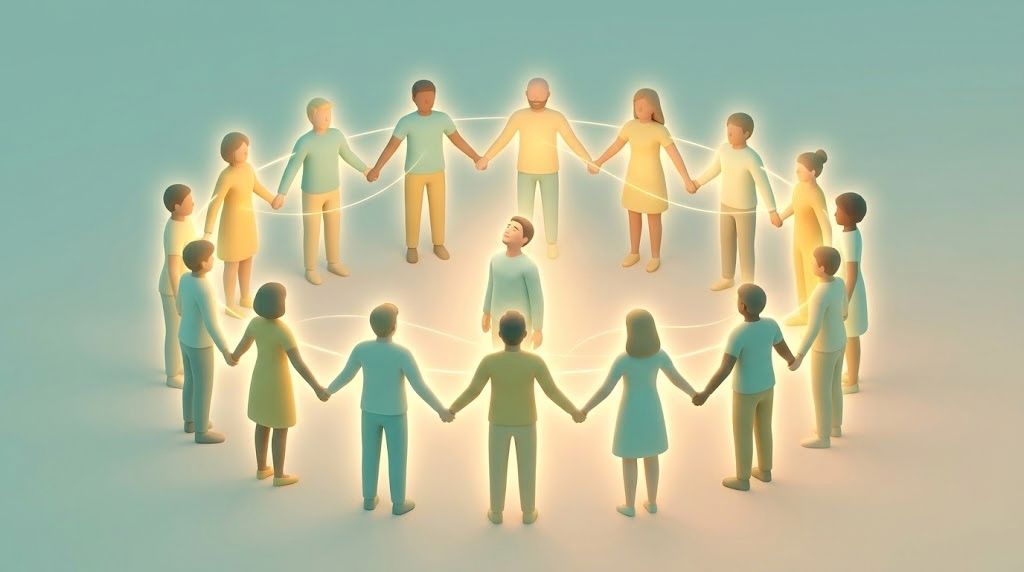
It combines three essential layers:
- Personal bonds: family, close friends, and partners.
- Professional support: psychologists, psychiatrists, and therapeutic companions.
- Institutional channels: emergency lifelines, health units, and community groups.
These layers do not operate in isolation. They complement each other. A psychologist notices what a friend misses. A friend steps in during late nights when the clinic is closed. An emergency lifeline supports both.
This network does not replace clinical treatment. It sustains the individual between appointments – and it is precisely during this gap that many crises escalate without proper support.
A strong network reduces the risk of suicide. A study cited by the Institute for Applied Economic Research (Ipea) shows that social isolation significantly increases this risk. The opposite is also true: individuals with consistent bonds demonstrate greater emotional resilience, even when facing severe conditions.
What many people misunderstand is thinking that this network only matters in extreme moments. It doesn’t. It needs to exist and remain active before a crisis arrives. Building bonds under pressure is far more difficult.

Why does everyone need a support network?
No one navigates an emotional crisis alone safely.
The World Health Organization estimates nearly 800,000 suicide deaths per year globally. In Brazil, the average reaches 32 people per day. That is over 11,000 lives lost every year – most of them in silence, without anyone knowing the depth of their pain.
These numbers are not abstract. They represent families, companies, and entire communities that could have taken action with better information and connection.
A support network serves three core functions:
- Detects early signs. People close by notice behavioral changes before any professional. One less call, a forced smile, a repeated excuse — those nearby notice.
- Reduces isolation. Frequent connections diminish feelings of extreme solitude. Feeling that someone cares does not cure a mental disorder, but it keeps it from progressing unchecked.
- Accelerates access to help. A well-structured network knows where to direct someone in crisis. It does not hesitate, minimize, or wait for the problem to resolve itself.
Weak bonds breed silence. Strong bonds spark action.
There is also a fourth, less visible effect that is equally important: normalizing conversations about mental health. When a support network truly functions, talking about emotional suffering ceases to be taboo. This alone saves lives.
Who makes up an effective support network?
A robust support network brings together different layers of protection. Each has a specific role – and none of them can be overlooked.
Family and close friends
This is the first circle of contact. It detects subtle changes in daily life and acts as the primary line of response during a crisis.
However, note this: this circle must be prepared. Wanting to help is not the same as knowing how to help. Family members and friends who understand the signs of emotional distress, practice active listening, and know when to refer to a professional make a real difference.
This does not require everyone to become an expert. It requires everyone to be present.
Mental health professionals
Psychologists, psychiatrists, and therapeutic companions provide ongoing technical care. They evaluate, diagnose, and manage treatment grounded in clinical evidence.
The EnLite Care connects patients with qualified therapeutic companions, complete with individualized therapeutic plans and periodic progress reports. This structured model goes beyond traditional consultation: it accompanies the individual in real life, not just in the office.
This type of support is particularly vital when patients face challenges with socialization, returning to work, or reintegrating into daily routines.
Community and support groups
In-person or digital groups unite individuals with shared experiences. They break down the stigma surrounding mental health and offer something clinical settings often lack: relatability.
Knowing that others have walked through the same points of despair — and emerged — holds a power of hope that is hard to quantify.
Groups tailored to specific conditions, such as depression, bipolar disorder, grief, or chemical dependency, offer targeted assistance. Meanwhile, general emotional well-being groups also play a key role in preventive mental health maintenance.
School and the workplace
Two environments rarely brought into discussions about support networks, yet they account for a significant portion of people’s time and relationships.
Teachers, peers, leaders, and HR teams can serve as vital contact points. A school trained to identify emotional distress in students; leadership that creates room for difficult conversations by offering initiatives such as therapy for bank workers and professionals under high pressure; a coworker who notices when something has shifted. These professional and educational connections offer more protection than it seems.
Institutional emergency channels
Every network must include crisis contacts. These numbers should be saved directly on your phone – not written down on a piece of paper tucked away in a drawer.
- 188 – Center for Life Valorization (CVV), 24/7 support every day.
- 192 – Mobile Emergency Medical Service (SAMU).
- Psychosocial Care Network (RAPS) – free public healthcare services via basic health units (SUS).
- CVV Chat – free online text support for those who prefer messaging over calls.
Save these contacts now. A crisis doesn’t wait for last-minute searches. In many cases, seconds matter.
The Support Circle: a framework to structure your network
Building a support network demands deliberate structure, not improvisation.
Most people assume they already have a support network. Yet when pressed to name who they would actually call in a real crisis — at 3:00 AM, during the worst moment of their lives — the silence is telling.
Use the SUPPORT CIRCLE framework to map your connections honestly:
Each layer fulfills a distinct function. None replaces another. Together, they form true protection – not just a symbolic one.
Review this map every six months. Relationships shift. Professionals change. Contacts get lost. Your network should reflect your current reality, not who you were close to two years ago.
How to build your support network in 6 steps

Building a support network takes practical action, not just good intentions. Many people delay this effort because they link the topic to a state of crisis that hasn’t happened yet. That is precisely the mistake.
You build a network when you have the strength to do so – not when you hit rock bottom.
Choose to act instead of staying complacent. Choose to build for genuine protection. The difference between the two choices reveals itself exactly when you least expect it.
Caring for the caregivers: leaders need a network too
Executives and founders rarely ask for help.
The pressure for results fosters a false image of invulnerability. Showing vulnerability can feel incompatible with leadership roles. That facade carries a heavy cost – and often the price is paid with the leader’s mental health.
High-performance leaders face burnout, anxiety, and isolation with growing frequency. The issue isn’t the pressure itself – it is the absence of safe spaces to process it. Those leading entire teams often have no one to call when things crumble internally.
Companies that overlook this reality pay in turnover, lost talent, and declining productivity. A mentally exhausted leader cannot guide with clarity; they react. And teams driven by reactive leadership produce inconsistent results.
Building a corporate support network protects both individuals and the business. They are not opposing goals – they are the same objective viewed from different angles.
The EnLite Corp develops mental health solutions for organizations, focusing on teams and leadership. Structured mental health initiatives in the workplace are not optional perks. They are a core business strategy.
Supported teams perform consistently. Exhausted teams perform with risk.
Protecting your team means safeguarding your operation.
How to maintain an active support network over time
Building the network is the first step. Keeping it active is the real challenge.
Many people establish a support system during a crisis only to let it fade once stability returns. It is an understandable pattern – but a dangerous one.
Key practices to sustain an active network:
- Regular check-ins. Set a minimum frequency to touch base with people in your inner circle. Don’t wait for a special reason.
- Professional updates. If you moved, changed health insurance, or entered a new stage of life, re-evaluate your access to mental health professionals.
- Ongoing community involvement. Stay engaged in mental health groups even during periods of stability. Community networks grow stronger through regular participation, not sporadic appearances in emergency moments.
- Clear communication with loved ones. People in your core group need to know they are part of your network. Saying it out loud — “you are someone I trust” — reinforces the bond and fosters mutual accountability.
Support networks that only exist on paper protect no one.
When to seek professional help?
Not every difficult moment requires immediate clinical intervention. Some demand urgent action.
Many people hesitate to reach out for professional help because they aren’t sure if what they are observing is severe enough. That hesitation is understandable – but it carries a high cost.
The practical rule is simple: when in doubt, seek help. A professional can assess whether the situation is urgent. You don’t need to — and shouldn’t — make that evaluation alone.
Reach out for professional support if the person:
- Expresses a desire to die or disappear, even if framed as a “joke.”
- Shows abrupt mood shifts, especially a sudden improvement following a period of crisis — this signal is particularly critical and frequently misinterpreted as recovery.
- Withdraws significantly and continuously, without an apparent cause.
- Loses interest in essential activities — work, hobbies, social relationships.
- Has a family history of suicide or severe mental health disorders.
- Demonstrates feelings of worthlessness, excessive guilt, or persistent hopelessness.
Choose to take action at any warning sign. Waiting allows the risk to grow.
If you identify these signs, call 188 or visit the nearest health facility. Do not wait for absolute confirmation before acting. If the situation feels immediate, call 192 or take the person to an emergency room.
Frequently asked questions about mental health support networks
What should I do if I don’t have a structured support network?
Start with the Support Circle. Identify one trusted person, find a go-to professional, and save emergency contacts today. You don’t have to build everything at once. One active connection is better than none.
How long does it take to build an effective support network?
Strong bonds take months to form. Start small: a regular conversation is already real progress. The key is not waiting for a crisis to begin the process.
Does a support network replace therapy or professional care?
No. A support network sustains someone between sessions and in spaces clinical care doesn’t reach. It does not replace diagnosis, treatment, or professional follow-up – it complements them.
How can I support someone who refuses help?
This is one of the most challenging situations for caregivers. Don’t force. Don’t minimize. Keep the bond active, communicate your availability clearly, and if there is immediate risk, contact professional help even without their consent. In emergency situations, protecting life takes precedence.
Can companies offer support networks to employees?
Yes. Corporate mental health programs, such as those by EnLite Corp, structure ongoing care for whole teams – through therapeutic support, workshops, and integrated wellness policies.
What should be done during an immediate crisis?
Call 188 (CVV) or 192 (SAMU). Do not leave the person alone. In case of imminent threat to life, seek immediate in-person emergency care.
How to talk about mental health with someone who finds it hard to open up?
Start by listening, not by offering solutions. Ask open-ended questions: “How are you really doing?” or “Is there anything bothering you lately?” Avoid minimizing (“this will pass”) or pressuring (“you need to get help”). Consistent presence opens up more space than a one-off sense of urgency.
Your support network starts with a choice
Weak support networks breed silence. Strong support networks foster survival.
Yet survival is not the ceiling. A well-built support network not only prevents the worst – it creates conditions for people to live better, with greater presence, deeper connection, and everyday emotional safety.
Have you mapped yours yet? Do you know who you would call if needed? Do you know who to call if someone close needs help?
If your answer wavers, that is your signal. Don’t wait for the next crisis to build what should already exist.
Continue this journey with the next article in the series: psychological first aid during emotional crises.